Dubai Breaks Ground on Nad Zabeel Innovation Campus
Five-year build puts research labs, incubators and industry links under one delivery body
Dubai has committed to building Nad Zabeel, a research, development and innovation campus in Zabeel Park expected to bring together more than 30,000 scientists, researchers and entrepreneurs each year. Construction and associated operations are slated for completion within five years. Delivery sits with the Dubai Future Foundation, the same body that will run the campus once it opens.
The physical scope is defined in operational terms. Nad Zabeel is to house laboratories, research centers, innovation incubators and facilities linking universities, global technology companies, investors, startups and government entities. Its technical focus covers artificial intelligence, robotics, advanced technology, urban technology, and health and environmental technologies, with the stated purpose of expanding Dubai’s research capacity and raising the contribution of future industries to the emirate’s economy.
The announcement was made under the witness of His Highness Sheikh Mohammed bin Rashid Al Maktoum, Vice President and Prime Minister of the UAE and Ruler of Dubai, and launched by Sheikh Hamdan bin Mohammed bin Rashid Al Maktoum, Dubai Crown Prince, Deputy Prime Minister, Minister of Defense, and Chairman of the Dubai Future Foundation’s Board of Trustees.
Operationally, the campus is conceived as more than laboratory space. It is designed to connect scientific research with investment, commercialization and regulation, hosting local and international investment firms, startups and entities involved in drafting future legislation. Accelerator and incubator programs on site are intended to help companies secure funding and scale.
Sheikh Hamdan said the campus would build on Dubai’s existing future-focused institutions by bringing research, development and innovation together to “transform knowledge into new economic and development opportunities.” He added that Dubai aims to anticipate global changes, address future challenges and attract international talent. Mohammad Abdullah Al Gergawi, UAE minister of cabinet affairs and managing director of the Dubai Future Foundation, described the campus as a mechanism for connecting researchers, universities, technology companies, investors and government entities, while strengthening Dubai’s position as a destination for scientific talent and knowledge investment.
Meanwhile, the delivery framework around the project already exists. Nad Zabeel forms part of the Dubai Research, Development and Innovation (RDI) Ecosystem, established in December 2025 under Sheikh Hamdan’s directives and overseen by the Dubai Future Foundation. That ecosystem pulls existing and planned RDI initiatives under a unified structure, supporting public- and private-sector organizations in developing solutions based on emerging technologies. Participating institutions include Dubai Future Labs and the MIT Senseable City Lab in Dubai.
The framework also runs the Dubai RDI Grant Initiative, which funds research projects and partnerships between universities, research centers and industry. Earlier in 2026, the Dubai Future Foundation backed 26 research projects led by 14 universities, selected from 358 submissions and involving 44 institutions across the UAE and 12 other countries.
The wider RDI program carries measurable delivery targets. It prioritizes health, environmental technology, smart infrastructure and human-machine intelligence, aiming for an annual GDP contribution of $5.45 billion by 2033, 120,000 jobs and 600 startups, backed by $204 million in funding over three years. Nad Zabeel is also tied to the Dubai Economic Agenda D33, which seeks to double the emirate’s economy by 2033 and place it among the world’s top three cities for business, with the campus expected to attract specialized talent and investment, support technology companies and startups, and link research to commercial development and future regulation.
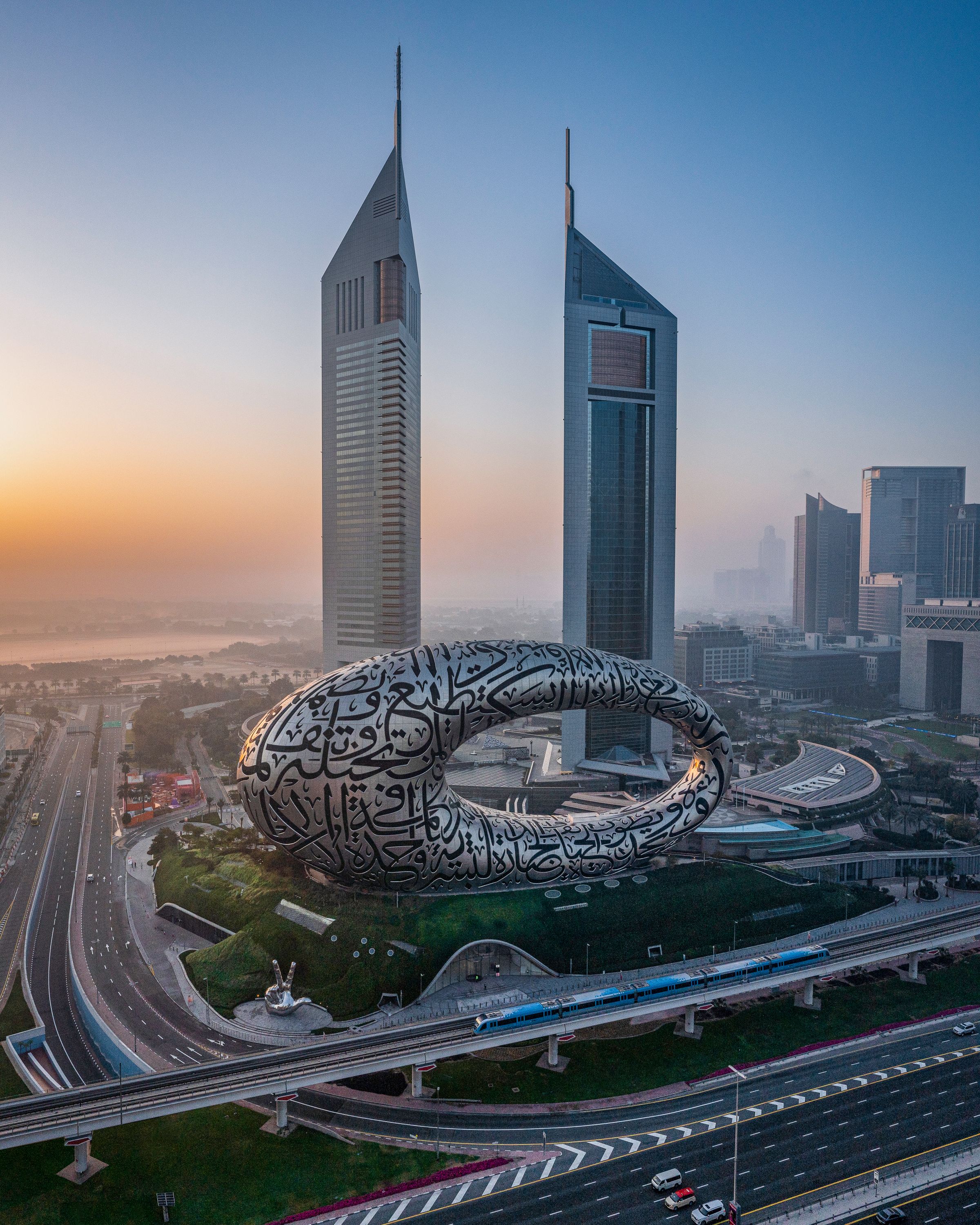
Location has been treated as part of the operational design. The campus sits within one kilometer of Burj Khalifa, the Dubai International Financial Center, the Museum of the Future, Emirates Towers and Dubai Frame, an arrangement intended to embed research activity in Dubai’s wider business ecosystem.
Nad Zabeel also extends work already underway at the Dubai Future Foundation, whose programs develop and test autonomous logistics technologies for ports and airports. With its dedicated facilities for collaboration between research institutions, businesses, investors and government entities, the campus is positioned as the next step in moving that pipeline of applied research toward commercial use.
Q&A
Who is responsible for delivering and operating Nad Zabeel?
The Dubai Future Foundation, which will also run the campus once it opens.
What is the completion timeline for the campus?
Construction and associated operations are slated for completion within five years.
What technology areas does the wider RDI program prioritize?
It prioritizes health, environmental technology, smart infrastructure and human-machine intelligence.
What are the wider RDI program's delivery targets?
It aims for a $5.45 billion annual GDP contribution by 2033, 120,000 jobs and 600 startups, backed by $204 million in funding over three years.